Services › New builds
Streams & rills
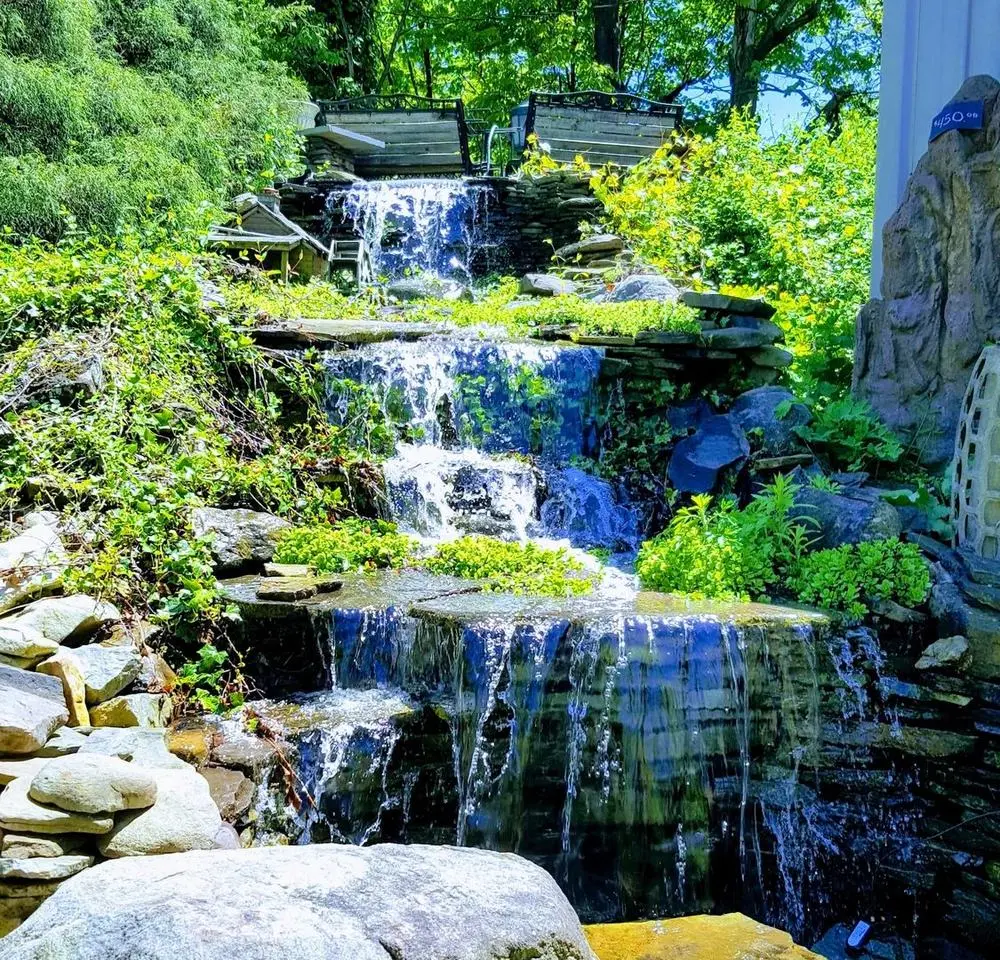
Water moving across a property rather than sitting in one place. Usually the best possible use of a slope you already have and were not sure what to do with.
A stream is the naturalistic version — irregular, rocky, planted along its edges. A rill is its formal cousin: a narrow, straight, hard-edged channel, often stone or concrete, running at a constant slope with small weirs. Same hydraulics, different vocabulary, completely different feel.
The numbers behind a stream that looks right
| Element | Target | What happens if you miss it |
|---|---|---|
| Gradient | 1–2″ of fall per 10 ft of run | Too flat and it looks like a puddle with ambition. Too steep and it reads as a chute rather than a stream. |
| Flow | ~100–150 GPH per inch of width at the widest point | Under-flowed streams look drought-stricken. Over-flowed ones wash out their own edges. |
| Velocity | Roughly 0.5–2 ft/sec | Below that you grow algae mats in the slack water. Above it, the sound goes from conversation to noise. |
| Turns | Sweeping, not square | Every sharp 90° costs pump energy forever, and looks engineered rather than found. |
Say this out loud before you build one. A stream is the single most expensive thing you can add to a pond's electricity bill. Every foot of lift is paid for every hour of every day for the life of the feature. It can absolutely be worth it — but it should be a decision, not a surprise that arrives with the first big summer bill.
Stream, or pondless falls?
They overlap, and the honest distinction is what you want at the bottom.
- Want the water to disappear at the end? That is a pondless waterfall with a stream attached.
- Want it to arrive somewhere — a pond, a basin, a planted pool? That is a stream feeding a feature.
- Want it formal and architectural, reading as built rather than natural? That is a rill.
Bring a photo of the slope and rough dimensions. It is a five-minute conversation once we can see the ground.