Gosanke
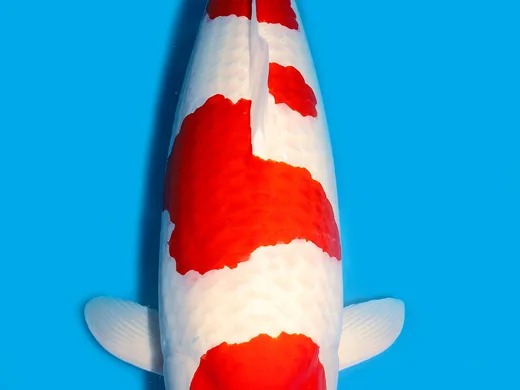
Kohaku 紅白
Red on white. Credited to Hiroi Kunizō at Utogi, and the source of the extinct Gosuke line every modern Kohaku descends from.
A history of koi
Not maliciously. Koi history is one of those subjects where a handful of English sentences got written down in the twentieth century, and everyone since has copied each other.
We went and checked. Japanese prefectural records, Chinese dynastic texts, peer-reviewed mitochondrial genetics, the OED, and the koi associations' own chronologies. A hundred and seven claims, thirty-seven of them contested enough to need a second opinion.
The true story is considerably stranger than the marketing version.
Where a popular claim does not survive checking, we say so and show what does. Where the evidence is genuinely unsettled, we say that too. Sources are listed at the foot of the page, and every picture here is public domain or freely licensed.
One
錦鯉 nishikigoi — "brocade carp" — is not an ancient name. It is a Taishō-era coinage that only became standard around 1940.
Dealers routinely claim the word is two hundred years old. Niigata Prefecture, Ojiya City, Nagaoka City and Japanese Wikipedia all disagree with them. What is two centuries old is the breeding; the word is younger than powered flight.
It is credited — hedged in Japanese with 「と言われている」, "it is said" — to Abe Kei, a prefectural fisheries official who saw a Taishō Sanshoku at a village show and reportedly said "this is truly a brocade carp."
Before that the fish had at least six names: irogoi (coloured carp), hanagoi (flower carp), moyōgoi (patterned carp), madaragoi (spotted carp), kawarigoi (odd carp).
At the 1914 Tokyo exposition that made these fish nationally famous, they were billed as 越後の変わり麵 — "Echigo's odd carp." The word "nishikigoi" did not yet exist at the moment koi became famous.
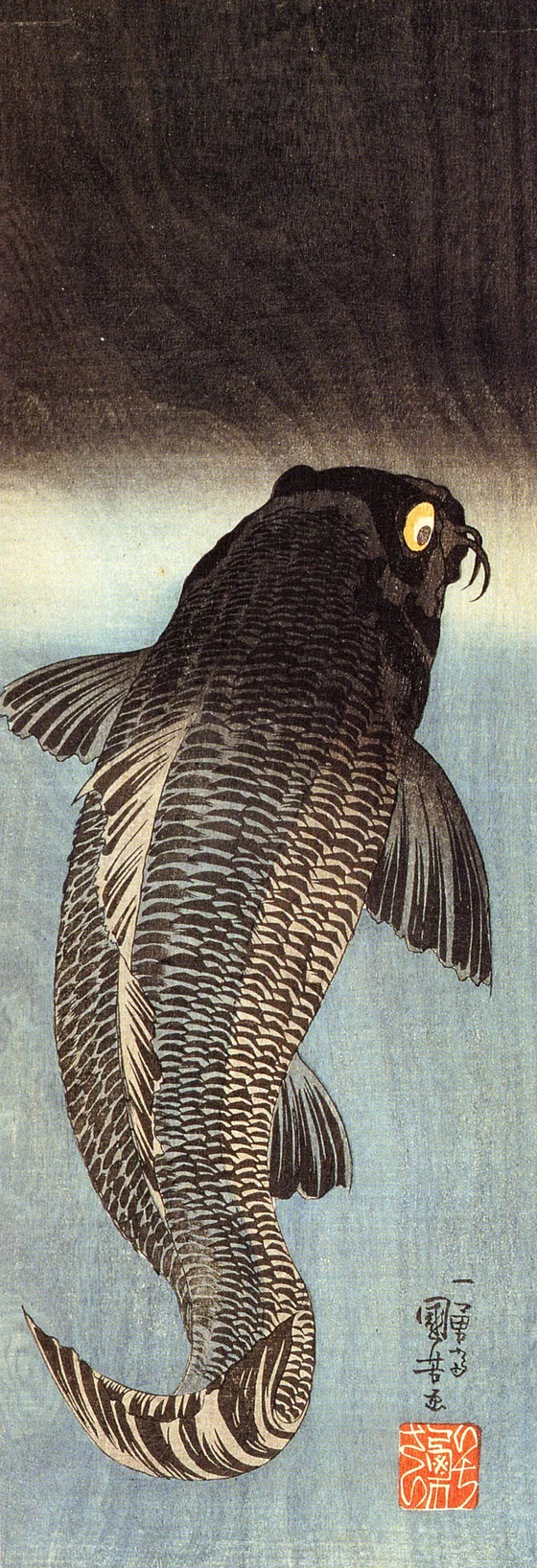
Utagawa Kuniyoshi, c. 1837. A carp, painted a lifetime before anyone called one a brocade carp.
Two
You will have read that koi sounds like the Japanese word for love, and that koi are therefore given as tokens of affection. The first half is true. The second half appears to have been invented in English.
In eighth-century Japanese, carp was ko₁pi₁ and love was ko₁pi₂. Different syllables. They only merged when an Old Japanese vowel distinction collapsed in the ninth and tenth centuries. No Nara-period poet could have made this pun.
Japanese compounds voice the second element: nishiki-goi, ma-goi, hi-goi. Love never does — hatsu-koi, kata-koi. The pun only exists on the bare, isolated word.
"Koi are given as gifts of love" traces to an uncited sentence in English Wikipedia, and from there into thousands of hobbyist pages and tattoo sites. Japanese sources give a completely different meaning: 立身出世 — worldly success, career advancement.
Cyprinus may derive from Kypris — Aphrodite, for the carp's fecundity — or from kypros, "henna-coloured." Ichthyologists cannot settle it either. Both names carry a love etymology; neither is proven.
Three
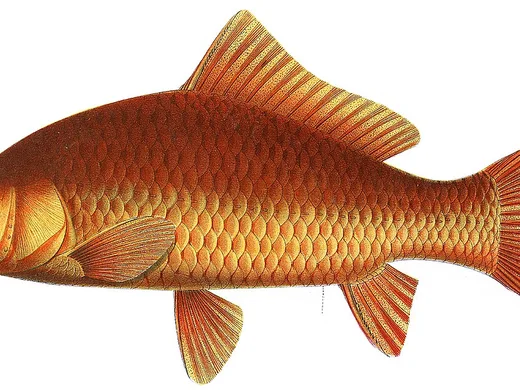
Cyprinus rubrofuscus, the Amur carp, in Bleeker's nineteenth-century plate. This, not the European common carp, is what a koi is.
Practically every book says koi are Cyprinus carpio, the common carp of Europe. They are not. They descend from Cyprinus rubrofuscus, the Amur carp of East Asia — a separate species.
The two were long lumped together as C. carpio haematopterus. They differ in meristics, and mitochondrial, microsatellite and genomic DNA all show a clean split between the European/West-Asian and East-Asian populations. Eschmeyer's Catalog and ITIS now treat rubrofuscus as its own species.
Two details make this better than a taxonomic footnote:
And here is the uncomfortable finding. Peer-reviewed mitogenomics (Mabuchi et al., 2014) found Japanese koi mitochondrially identical to the Oujiang colour carp — a red-and-white food fish farmed in Zhejiang rice paddies for something like twelve hundred years. By maternal DNA, koi's closest documented relative is Chinese, and it is a peasant crop, not a Japanese ornamental.
A footnote with teeth: the name C. carpio haematopterus was not killed by genetics at all. It fell to an 1820 naming technicality by Rafinesque. Much of the literature never got the memo — including, still, some of Niigata Prefecture's own documents.
Four
Every koi history cites Chinese records of coloured carp from the fourth and fifth centuries. Those records are real. They are about a different genus.
The famous early Chinese "coloured carp" are the ancestors of the goldfish — Carassius auratus, not Cyprinus. Koi literature has spent a century borrowing the goldfish's pedigree.
China's genuine parallel is elsewhere and less famous: Oujiang colour carp in Zhejiang and Xingguo red carp in Jiangxi — red-and-white patterned Cyprinus, claimed to Tang-dynasty origins, still farmed in paddies. That is the fish koi actually matches.
Japan's ornamental-fish culture also began with an import: the goldfish, traditionally at Sakai in 1502. Koi arrived three centuries later into a hobby that already existed — including its convention of viewing fish from above, uwami.
Two stock claims that do not survive. "The Tang banned carp, so carp-keeping moved to Japan" — what the ban actually produced was Chinese polyculture of grass, silver, bighead and black carp. And "the Nihon Shoki records coloured carp in 720 AD" — the passage mentions carp in a pond and says nothing about colour.
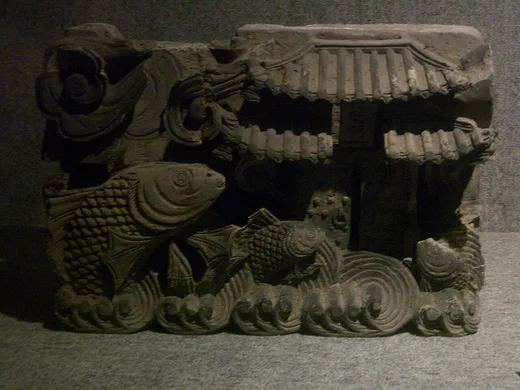
Qing-dynasty brick carving, Yangzhou. Carp leaping the gate on the Yellow River to become dragons — the source of the perseverance symbolism.
The founding legend has no carp in it. The Hou Hanshu and the Tang-quoted Sanqin Ji speak of "fish and turtles" and "great fish of rivers and seas." The carp only arrives in the Taiping Guangji version of 978 CE — roughly five centuries after the story itself.
Five
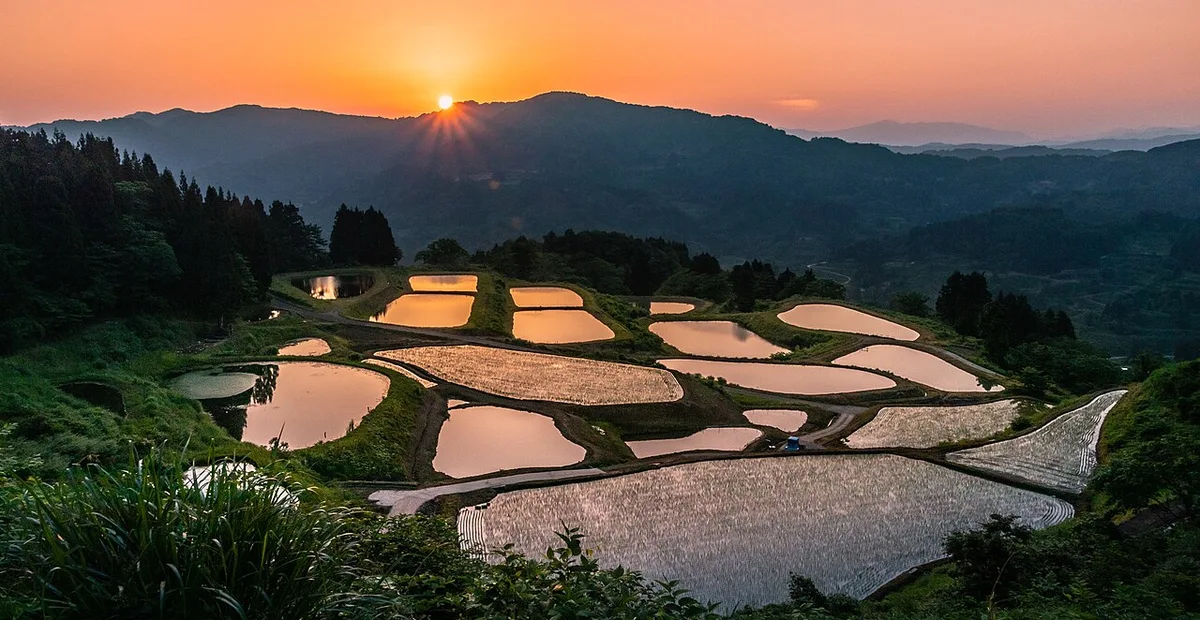
The real story starts in the mountain hamlets of the old Nijūmura-gō district — today Yamakoshi and Ojiya, Niigata. Deep snow, steep ground, rice.
Cold groundwater damages rice. The topmost terrace step was a solar heating basin — and raising carp in it was explicitly the pond's secondary use. The landscape was engineered for the crop; the fish were a by-product.
Snowed in for months, the villages kept black magoi in the paddies as food. The word magoi, "true carp," is a retronym — it only became necessary once there were coloured mutants to distinguish it from.
In 1875 the coloured-carp market became such a speculative bubble that Niigata Prefecture banned ornamental carp breeding outright. The breeders had to petition to get it lifted.
Mottled carp are recorded in Shizuoka in 1843, and a three-colour carp was on show in a Takamatsu park in 1900. Colour happened in lots of places. What Niigata alone had was a century of sustained selection.
The "ancient" landscape is largely 1970s farm policy. About 80% of the famous terraced ponds are converted rice paddies, and the conversion boom was driven by the Japanese government's 1970 rice acreage-reduction programme. And in 1973, the world capital of koi averaged 7.4 ponds per household, with 95% of operations run by one or two people. A peasant side-business, not an estate industry.
Six
Koi variety history reads like a tidy chronology. Under checking, roughly half of it is tradition rather than record.
Red on white. Credited to Hiroi Kunizō at Utogi, and the source of the extinct Gosuke line every modern Kohaku descends from.
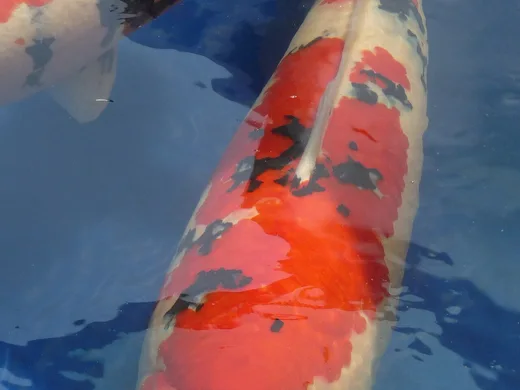
Kohaku plus black. "Sanke" is not short for "Sanshoku" — it is a fossilised reading of the older spelling 三毛, "three-hair," the same word as in mikeneko, the calico cat.
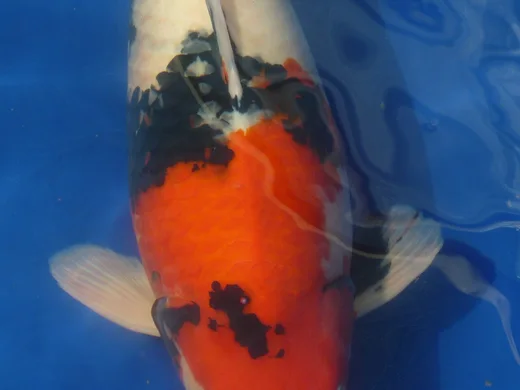
Black ground with red and white. Credited to 星野重吉 — rendered "Jukichi Hoshino" in every English source, but read Hoshino Shigekichi in Japanese.
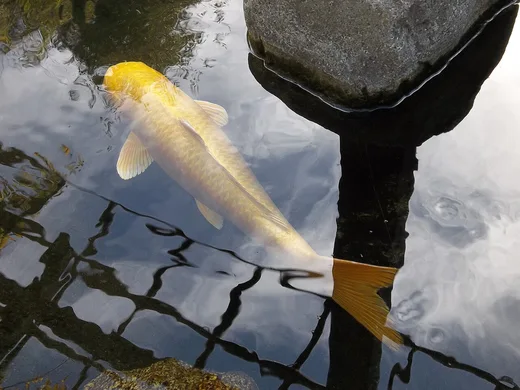
The metallic single-colour class, from Sawata Aoki's line. The founder magoi was caught in 1921; the variety took a quarter-century to fix.
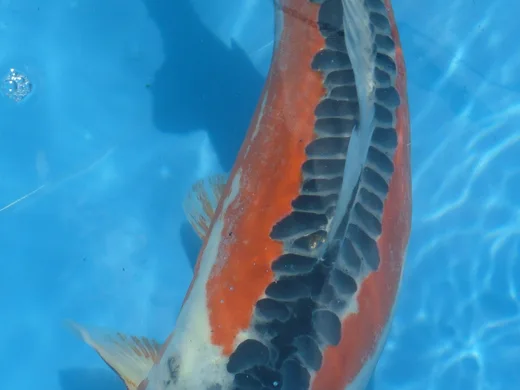
The scaleless descendant of Asagi — and not a Niigata fish at all. Made in Tokyo by a goldfish dealer, from an Austrian scaleless carp bred in 1782 and a 1904 government shipment from Munich.
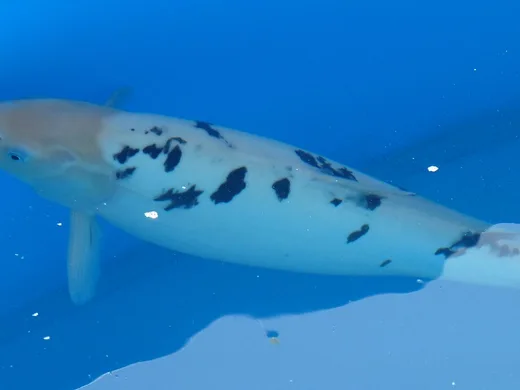
The mirror carp came to Japan as a wartime food-security project, not for beauty — Munich to the Imperial Fisheries Institute during the Russo-Japanese War. Of thirty fish shipped, five 6 cm fry survived. Four were female.
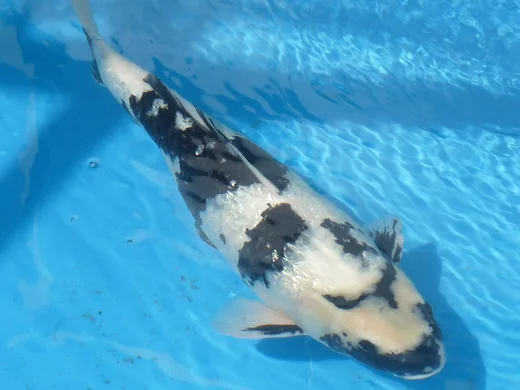
Black-based two-colour fish, and the reflective-scale class laid over the top of everything else.
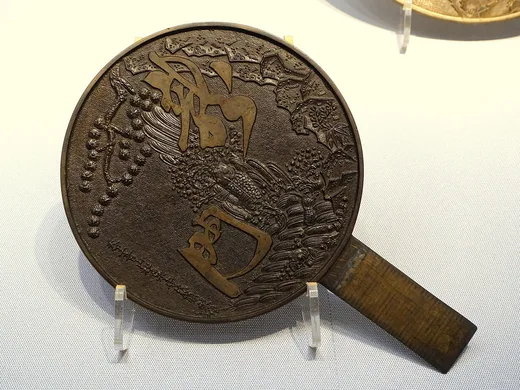
The oldest variety, and the only one with no founder and no date. Japanese sources openly say when it mutated and how it was named are simply not transmitted.
Doitsu koi carry a lethal gene. Homozygotes die at hatching, so nude × nude crosses lose about a quarter of the brood — and the lethality shows up specifically in crosses involving Asian-origin parents.
Seven
The Tokyo Taishō Exposition at Ueno is where koi stopped being a provincial oddity. It is also the only major date in koi history with a contemporaneous printed record behind it — and the popular version still gets it wrong in three places.
Not gold, not first prize. At the same exposition, a silver is what DAT's motorcycles took. Koi placed respectably, not sensationally.
Hirohito was a schoolboy of twelve or thirteen, not formally invested as Crown Prince until November 1916, and not emperor for another twelve years. Sources that write "Emperor Hirohito" are wrong by decades.
Eight fish presented after closing; koi donated to the Imperial Palace; or the prince simply lingering at the tank. The promotion association itself hedges.
The first koi show is dated to 1912, in a primary school in Kizawa village. Ueno was not koi's debut in competition — it was koi's debut in front of Tokyo.
Eight
Koi went global on an unglamorous invention: the oxygen-filled plastic shipping bag, which in the 1960s made a living fish air-freightable.
Though the export story starts earlier than the bags. Koi were sold on the roof of the Nihonbashi Takashimaya department store in the 1930s, and 300 went to the 1939 Golden Gate International Exposition in San Francisco — not, as usually stated, the New York World's Fair.
Niigata is the birthplace. Hiroshima is the power. Sakai Fish Farm, five hundred kilometres from the ancestral valley, had taken thirteen All Japan Grand Championships by 2024.
And the top prize in Japan's national show now routinely leaves Japan. The 2021 Grand Champion — a 102 cm Kohaku — was owned by a collector from mainland China.
The most expensive koi ever sold went for ¥203 million on 4 October 2018 — at Sakai's own private auction in Hiroshima, not at the All Japan show, and a full year before she won her second national title.
She was dead within the one-year warranty. The breeder settled with a ¥100 million replacement fish. Almost no popular retelling of the record mentions it.
The number nobody prints. Sakai hatches roughly 32 million koi a year and discards about 97% at the first cull, then two-thirds of what is left at sixty days. Every show fish stands on an industrial scale of rejection.
Nine
Carp is simultaneously one of the most valuable ornamental animals on earth and one of the most destructive invasive species on earth. Both statements are about the same animal.
The United States government built carp ponds on the National Mall, beside the Washington Monument, and in 1882 posted 260,000 carp to 298 of 301 congressional districts. An 1889 Potomac flood released about four million more.
Koi are illegal in Australia, which has spent over A$13 million evaluating the deliberate release of koi herpesvirus into the Murray–Darling. The target date has slipped from 2018 to 2028.
Not a food-carp relative — koi. An "unwanted organism," illegal to possess, and up to 80% of fish biomass in the lower Waikato.
KHV was first isolated in Israel in 1998. Japan's outbreak began in food carp in net pens on Lake Kasumigaura, killing 660 tonnes in October 2003, and spread nationally because infected fish had already reached restaurants and wholesalers.
A precise irony: koi are now classified as Cyprinus rubrofuscus, so the IUCN "worst invasive species" listing everyone pins on koi is, strictly, for a different species.
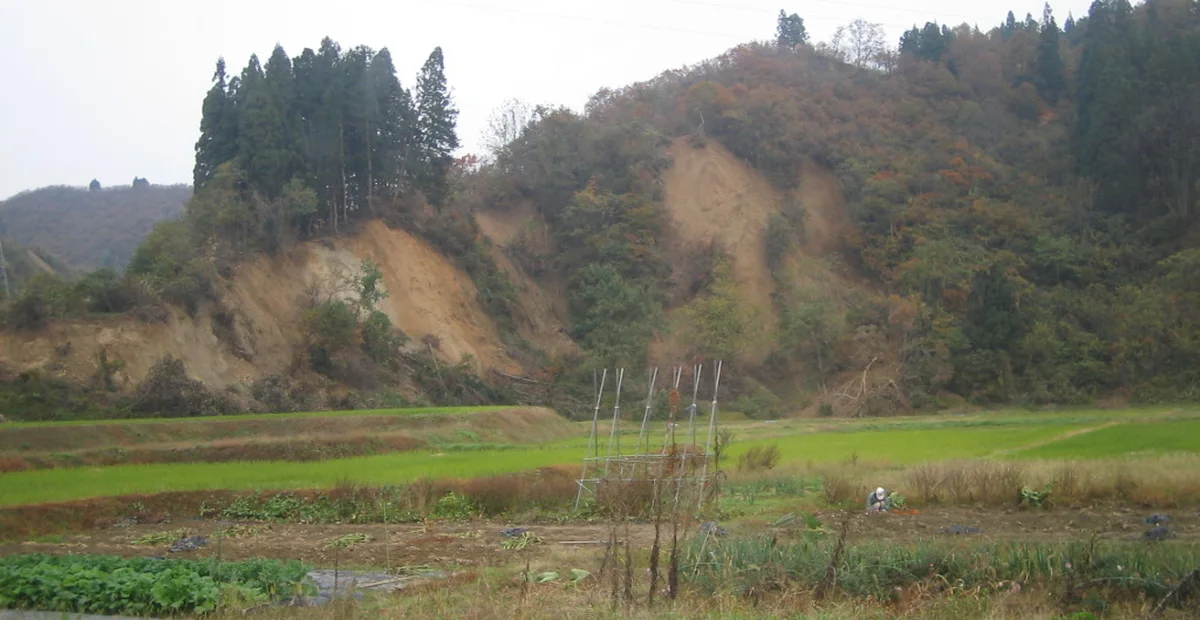
Ten
On 23 October 2004 the Chūetsu earthquake hit Yamakoshi directly. The terraced ponds were cut into landslide-slumped benches — terracing was a landslide-control practice. The geology that made koi possible is the geology that buried them.
The village was evacuated entirely. Koi were lifted out by helicopter. The national koi show was cancelled two years running — once for the earthquake, once for koi herpesvirus the year before.
Twenty years on, Yamakoshi has about 750 residents against a pre-quake 2,100 — and more than 1,600 NFT "digital villagers" who vote on the local budget. The rebuilt village has more virtual citizens than real ones.
And in 2023 the fish became a diplomatic hostage: China let the quarantine registration for Niigata's export facility lapse amid the Fukushima treated-water dispute. China had been taking around a fifth of Japan's koi exports.
The carp before the koi
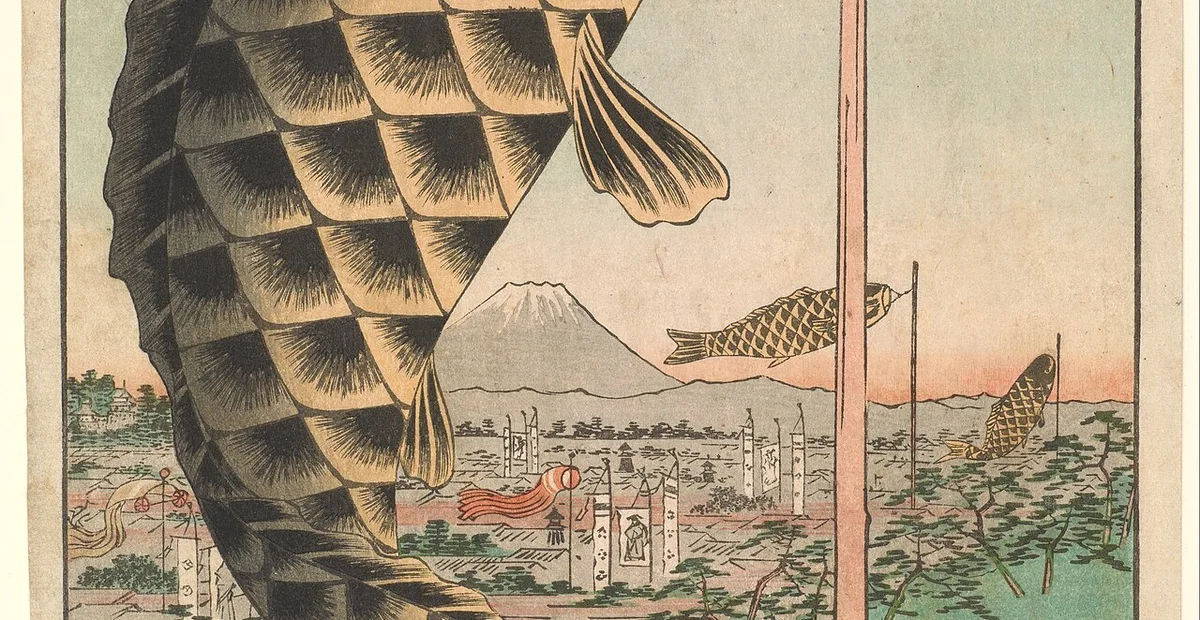
Long before anyone bred a Kohaku, the carp was already doing symbolic heavy lifting in Japanese art — climbing waterfalls, carrying boy-heroes, and flying over rooftops every May. All of these are public domain.
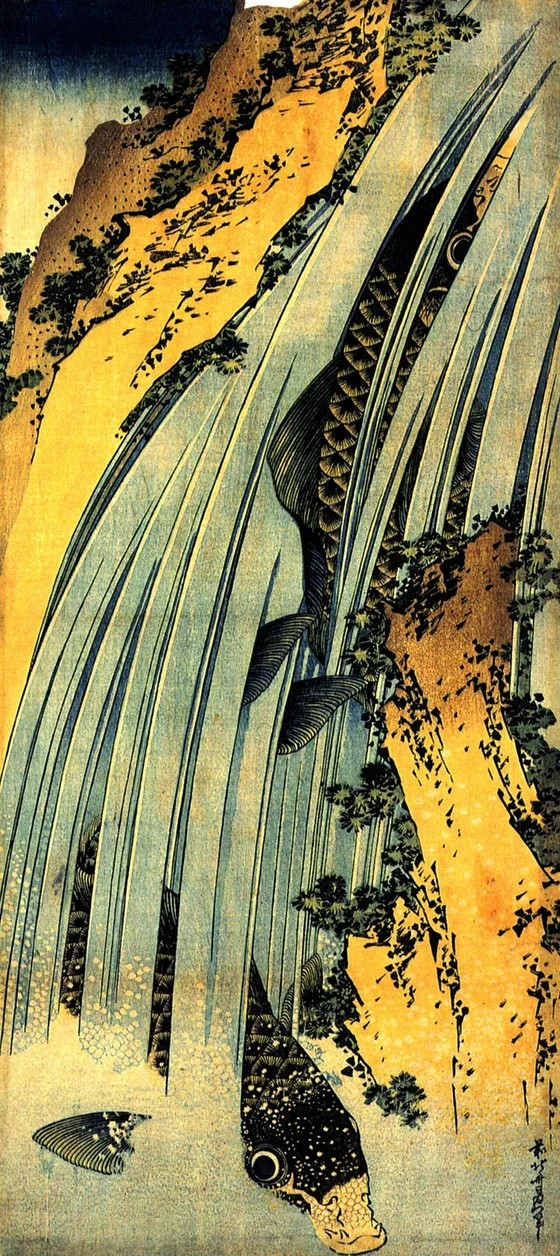
The Dragon Gate motif at its most muscular — two fish fighting a vertical river.
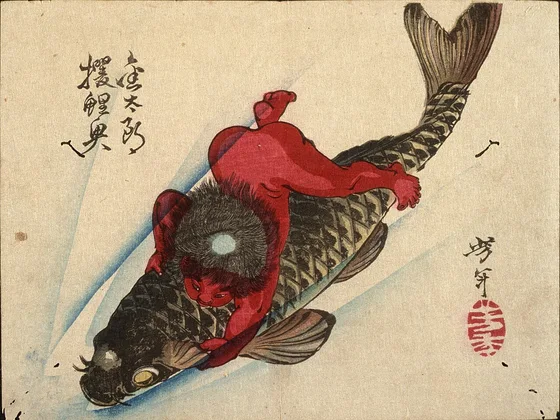
The boy-hero astride a giant carp — strength and perseverance in one image.
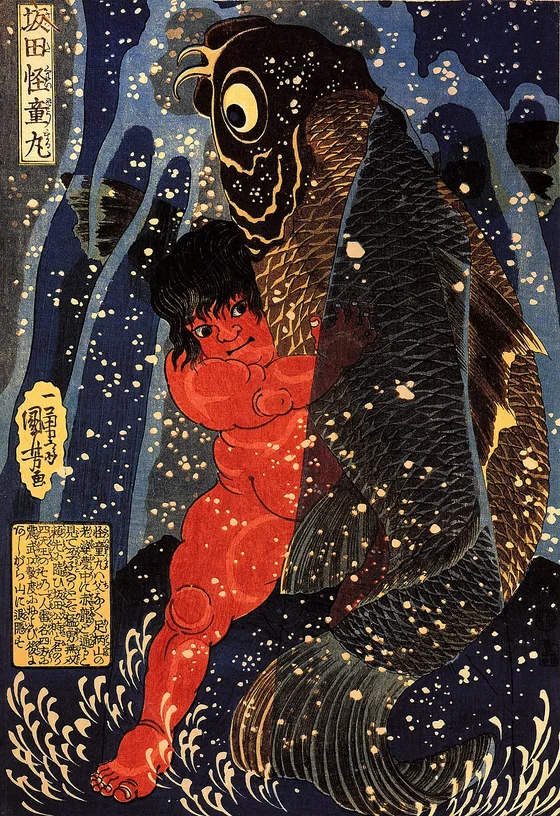
Wrestling a giant carp beneath a waterfall. The fish as worthy opponent.
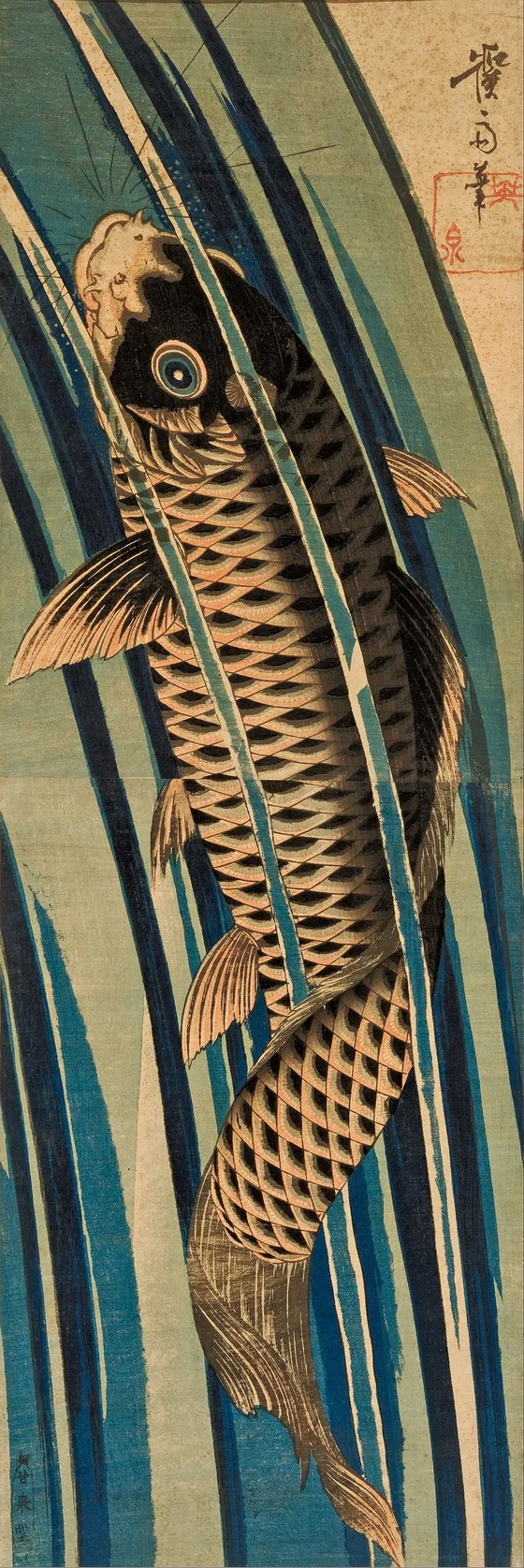
The single most repeated image in the whole tradition — and it predates koi entirely.
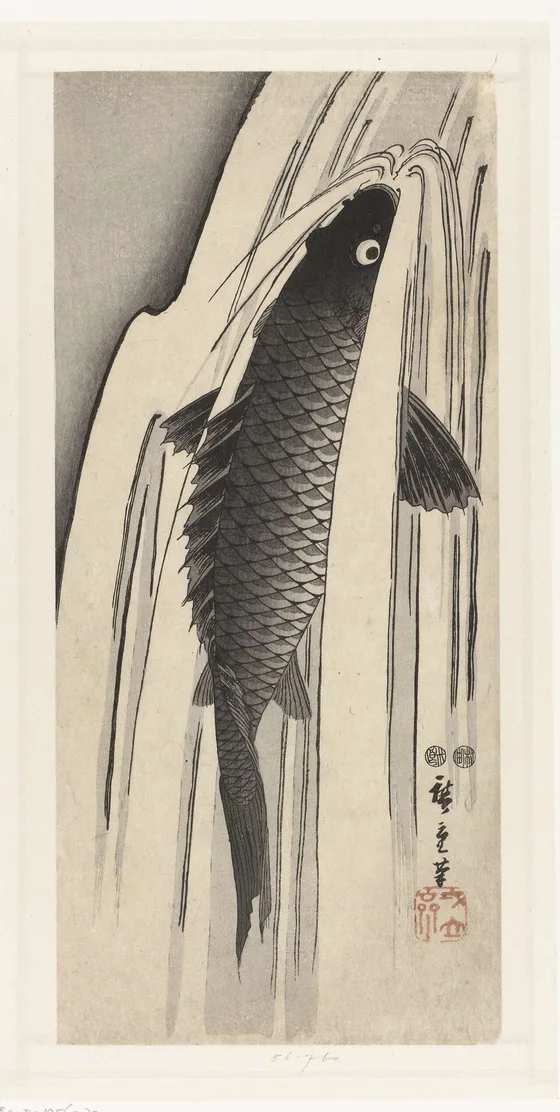
Hiroshige's carp, sixty years before Niigata's fish reached Tokyo.
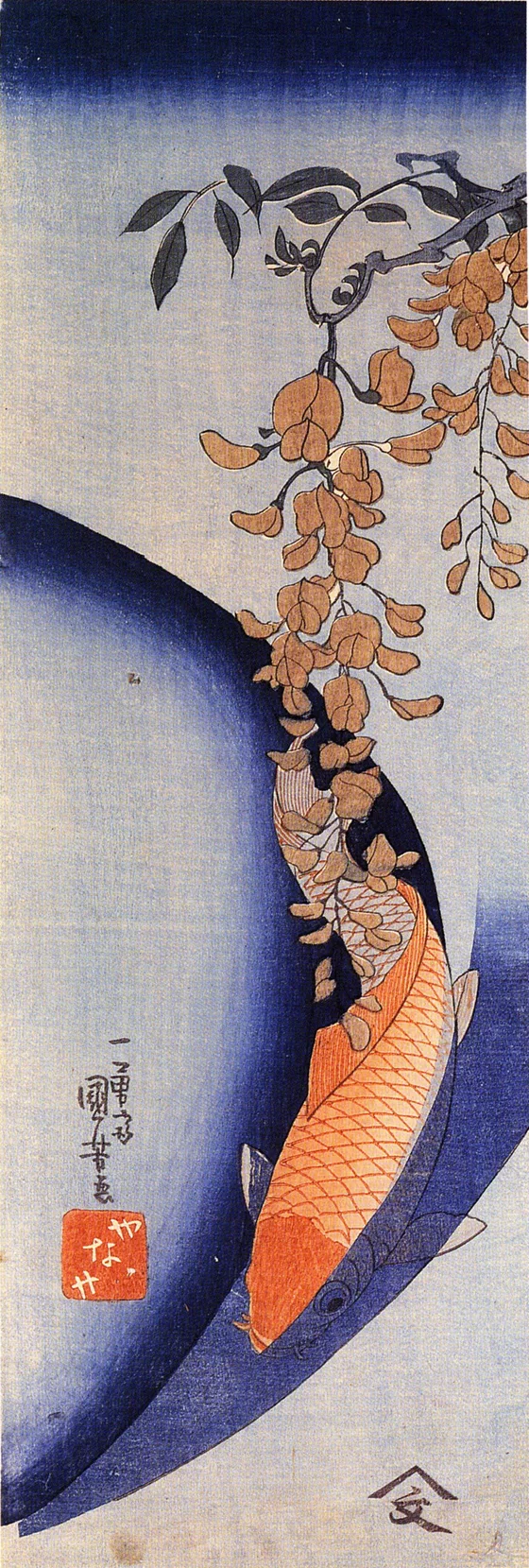
A higoi — red carp — in art well before the breeders fixed the colour.
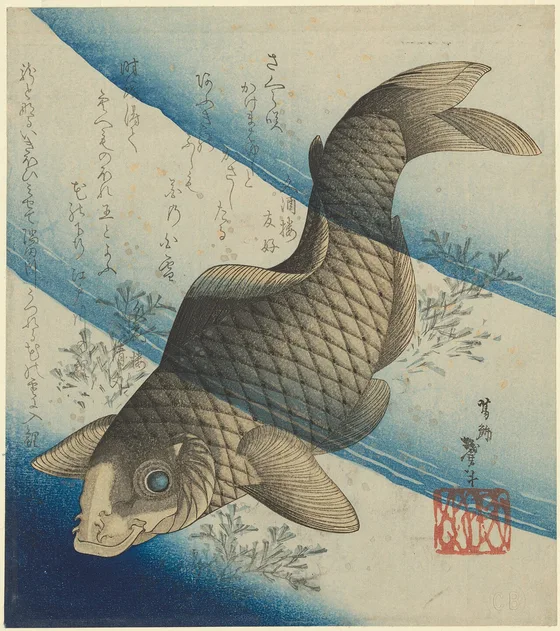
A privately-printed Edo deluxe edition, metallic pigments and all.
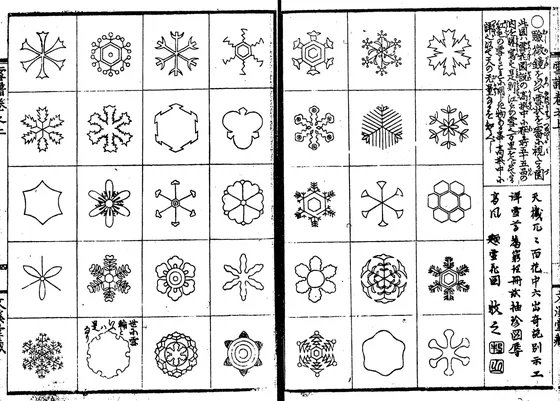
Snow crystals from Hokuetsu Seppu — the classic account of the Niigata winters that made the ponds necessary in the first place.
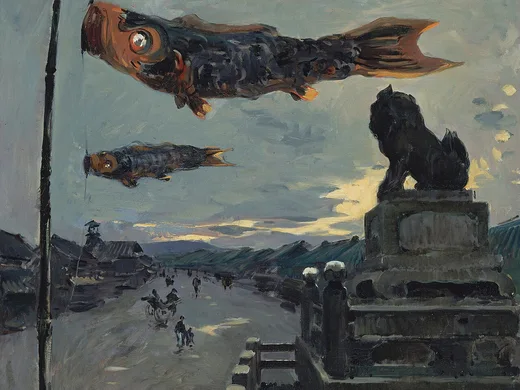
A 19th-century Western oil painting. The streamers were a workaround for a class ban — commoners could not fly the samurai's military standards, so they flew fish instead.
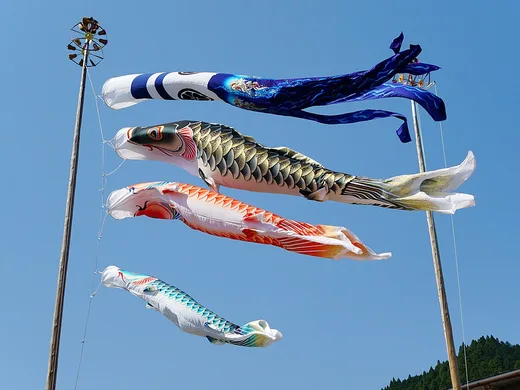
Modern mass koinobori over a river in Tottori. In the 1931 song, black is the father and red is the child — the mother only appears around 1960.
Strip out the invented parts and the story is better, not worse.
A food fish, kept in heating basins by snowed-in rice farmers, in a district so unstable the hillsides periodically slide into the valley. Somebody noticed a coloured one and did not eat it. A hundred years of patient selection later, in a country that had to be told what to call them, those fish became the most valuable ornamental animal on earth — and then the mountain fell on the village and they started again.
Nobody needed to embroider that.
Method & credits
Eight parallel research passes across etymology, taxonomy, Chinese antecedents, the Niigata villages, variety chronology, the 1914 exposition, the modern export trade, and the cultural and ecological record. 107 findings; every one graded solid, contested or likely-myth. The 37 that were not solid went to a separate verification pass whose job was to find where each claim originated — because a surprising number trace to a single English book, a dealer's catalogue, or an uncited line on Wikipedia.
Sources leaned on Japanese prefectural and municipal records (Niigata, Ojiya, Nagaoka), Japanese Wikipedia where it cites primary material, Eschmeyer's Catalog of Fishes and ITIS, the OED, the ETYFish Project, FAO aquaculture histories, museum catalogues, and peer-reviewed mitogenomics — in preference to hobbyist sites, which overwhelmingly copy each other.
Where we could not settle something, the page says so.
Koinobori over Edo — Utagawa Hiroshige, Public domain, Wikimedia Commons. · Yamakoshi terraces — Koichi_Hayakawa, CC BY 4.0, Wikimedia Commons. · 2004 Chūetsu landslide — Naoki Sato, CC BY-SA 2.0, Wikimedia Commons. · Yamakoshi valley — Koichi_Hayakawa, CC BY 4.0, Wikimedia Commons. · Two carp in a cascade — Katsushika Hokusai, Public domain, Wikimedia Commons. · Kintarō and the carp — Yoshitoshi, Public domain, Wikimedia Commons. · Kaidōmaru and the carp — ?, Public domain, Wikimedia Commons. · Black carp — ?, Public domain, Wikimedia Commons. · Red carp under wisteria — ?, Public domain, Wikimedia Commons. · Carp ascending a waterfall — Keisai Eisen, Public domain, Wikimedia Commons. · Carp and waterfall — Rijksmuseum, CC0, Wikimedia Commons. · Carp among waterweeds — Katsushika Taito II, Public domain, Wikimedia Commons. · Snow crystals, Hokuetsu Seppu — Suzuki Bokushi, Public domain, Wikimedia Commons. · Cyprinus rubrofuscus plate — Published by Zoologische Mededelingen, at http://www.zoo, CC BY 3.0, Wikimedia Commons. · Kohaku — Martin Kammerer, CC BY-SA 4.0, Wikimedia Commons. · Taishō Sanke — Maxikoi, CC BY-SA 3.0, Wikimedia Commons. · Shōwa Sanshoku — Maxikoi, CC BY-SA 3.0, Wikimedia Commons. · Shusui — Maxikoi, CC BY-SA 3.0, Wikimedia Commons. · Doitsu Shiro Bekko — Maxikoi, CC BY-SA 3.0, Wikimedia Commons. · Gin Rin Shiro Utsuri — Maxikoi, CC BY-SA 3.0, Wikimedia Commons. · Yamabuki Ogon — Lhimec, CC0, Wikimedia Commons. · Dragon Gate brick carving — User:Vmenkov, CC BY-SA 3.0, Wikimedia Commons. · Edo bronze mirror — Daderot, Public domain, Wikimedia Commons. · Koinobori, Chizu — 663highland, CC BY 2.5, Wikimedia Commons. · Carp banners over Kyoto — Louis Dumoulin, Public domain, Wikimedia Commons. · Nagaoka koi show — KoiQuestion, CC BY-SA 2.0, Wikimedia Commons. · Nishikigoi no Sato, Ojiya — Asturio Cantabrio, CC BY-SA 4.0, Wikimedia Commons. · Yamakoshi rice terraces — yoshi s, CC BY-SA 3.0, Wikimedia Commons.


